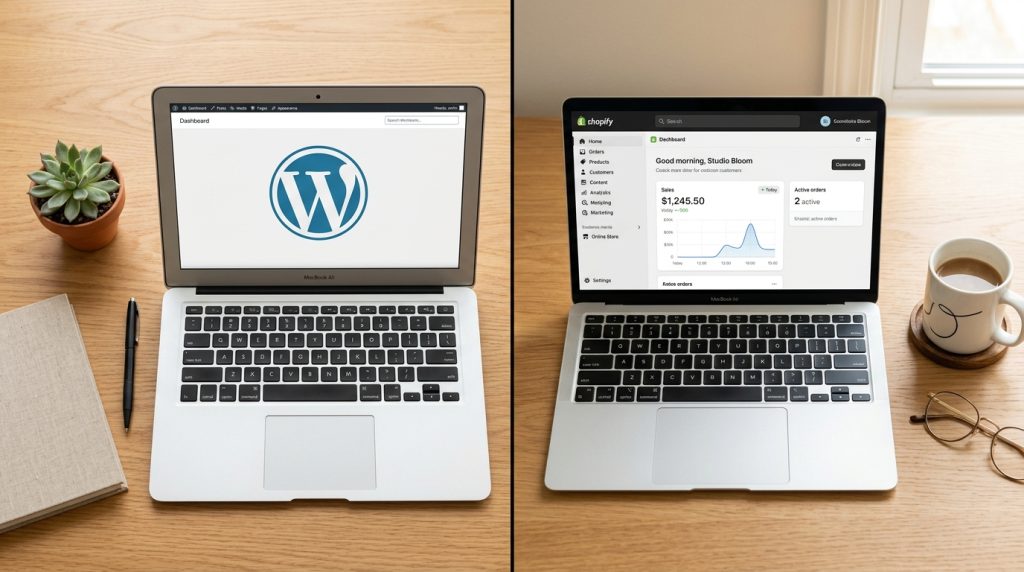
Comparing WordPress vs Shopify in 2026? This guide gives you an honest cost breakdown, a full SEO comparison, and a clear verdict on which platform fits your business model. No affiliate links. No bias.
Platform Comparison · Web Development · 2026
WordPress vs Shopify: Which Is Better for Your Business in 2026?
Both platforms power millions of businesses globally. But they solve different problems. Choose the wrong one and you waste money, time, and growth potential.
Most comparison articles on this topic are written by people with affiliate commissions riding on your decision. They get paid when you sign up for Shopify. So they lean Shopify. This article has no affiliate links. The answer depends entirely on what your business actually needs.
Here is the honest breakdown.
Open-source CMS with WooCommerce
Powers 43.4% of all websites globally. Free to use. You own everything. Requires more setup and ongoing management.
Fully managed ecommerce platform
Powers 5.5 million stores globally. 30% US market share. Everything is handled for you. Monthly subscription required.
The Core Difference: What Each Platform Is Built For
WordPress started as a blogging tool. It evolved into the most flexible website platform on the planet. With WooCommerce added, it becomes a fully capable ecommerce store. But ecommerce is not its core identity.
Shopify was built for one purpose: selling products online. Everything in its architecture, its dashboard, its apps, its checkout system, is optimised for ecommerce. It does nothing else.
That distinction matters more than any feature comparison. If your primary goal is selling products, Shopify was built for you. If your business needs content, services, blogging, SEO, and ecommerce together, WordPress is more capable.
Cost Comparison: What You Actually Pay
The marketing around cost for both platforms is misleading. WordPress claims to be free. Shopify quotes $29 a month. Neither figure reflects reality.
Year 1 Total Cost: WordPress vs Shopify
Head-to-Head Comparison: Every Factor That Matters
| Factor | WordPress | Shopify | Winner |
|---|---|---|---|
| Setup speed | 2 to 4 weeks for a proper setup | Live in 24 to 72 hours | Shopify |
| Monthly cost | Low ongoing costs after setup | $39 to $399/month plus apps | WordPress |
| Ecommerce features | Excellent via WooCommerce | Best in class, built from the ground up | Shopify |
| SEO capability | Superior with Yoast/RankMath, full control | Good but limited on technical SEO | WordPress |
| Content and blogging | Unmatched. Built for content first. | Basic blog functionality only | WordPress |
| Design flexibility | Unlimited customisation | Good but restricted to Shopify’s framework | WordPress |
| Ease of use | Steeper learning curve | Beginner-friendly dashboard | Shopify |
| Security | You manage updates and security | Fully managed, PCI compliant | Shopify |
| Scalability | Unlimited with right hosting | Excellent for high-volume stores | Tie |
| AI search visibility | Superior with structured content | Shopify has Agentic Storefronts for product AI | Tie |
| Ownership | You own everything completely | Platform owns your store infrastructure | WordPress |
| Transaction fees | Zero platform fees | 0.5% to 2% unless using Shopify Payments | WordPress |
| Mobile commerce | Good with right setup | Excellent. 68% of Shopify traffic is mobile. | Shopify |
| Support | Community forums and developer support | 24/7 live support included | Shopify |
SEO: The Factor Most Business Owners Get Wrong
This is where the comparison matters most for long-term growth. SEO determines whether buyers find you organically on Google without paying for ads. Get this wrong and you pay for traffic forever.
WordPress wins on SEO flexibility. You control your URL structure, your schema markup, your meta tags, your site speed configuration, your internal linking, and your content architecture completely. Shopify has improved its SEO significantly in 2026 but still restricts access to several technical elements.
For service businesses and content-heavy strategies, WordPress SEO capability is significantly superior. For product-focused ecommerce with less content strategy, Shopify’s built-in SEO tools are sufficient.
Who Should Choose WordPress
Your Business Fits This Profile
- You are a service business: agency, consultant, coach, freelancer
- You need a strong content and blog strategy to generate organic leads
- You sell both products and services and need full flexibility
- You want maximum SEO control to compete in organic search
- You want to keep ongoing monthly costs low after the initial build
- You need full ownership of your platform with no vendor lock-in
- You have a developer or agency managing your site (or want one)
- Your business is in a country where Shopify Payments is unavailable
Who Should Choose Shopify
Your Business Fits This Profile
- You sell physical products and ecommerce is your entire business model
- You want to be selling within days, not weeks
- You have no technical knowledge and do not want to hire a developer
- You sell in-person as well as online and need a POS system
- You have high transaction volume and can use Shopify Payments to avoid fees
- You want 24/7 support included without managing a developer relationship
- You are scaling fast and need proven infrastructure for high traffic
The Myth of “Just Start With Shopify and Switch Later”
Many business owners are told to start with Shopify because it is easier, then switch to WordPress when they grow. This advice costs businesses thousands of dollars.
Migrating from Shopify to WordPress means rebuilding your store from scratch. Your product pages, your SEO history, your URL structure, your customer data migration. None of it transfers cleanly. Businesses that switch platforms typically lose 3 to 6 months of SEO rankings in the process.
Choose the right platform for your long-term business model from the start. The short-term ease of Shopify setup is not worth a painful and expensive migration two years later.
The Verdict for Service Businesses and Digital Agencies
If you are reading this as a service business owner in the USA or UK looking to build a professional website that generates leads, the answer is clear.
WordPress wins for service businesses. It gives you superior SEO control, unlimited content flexibility, lower ongoing costs, and full ownership. The additional setup complexity is handled by your developer once and then you manage it easily day to day.
Shopify is the better choice if you are building a product store and selling online is your entire business model. Its ecommerce infrastructure, mobile checkout performance, and built-in selling tools are genuinely superior to WooCommerce for pure product selling.
Quick Decision Guide
Match your situation to the right platform in 30 seconds.
Frequently Asked Questions
Can I use Shopify for a service business?
You can, but it is not built for it. Shopify’s architecture is optimised for product catalogues, inventory, and checkout flows. Service businesses need strong content pages, lead capture forms, blog functionality, and SEO control. WordPress handles all of these better than Shopify for service-based businesses.
Is WordPress harder to manage than Shopify?
The initial setup is more complex. Once set up correctly, day-to-day management of WordPress is straightforward. Writing blog posts, updating pages, and adding products in WooCommerce are all simple tasks. The difference is that you manage your own hosting and updates, whereas Shopify handles those for you automatically.
Which platform is better for SEO in 2026?
WordPress is better for SEO overall. With Yoast or RankMath, you get granular control over every technical SEO element. Shopify has improved significantly but still restricts access to certain URL structures and technical configurations. For content-driven SEO strategies, WordPress is the clear choice.
What happens if I want to switch from Shopify to WordPress later?
Migration is possible but painful. You will need to rebuild your store, migrate product data, redirect all URLs, and accept a temporary drop in SEO rankings during the transition. The migration typically costs $2,000 to $8,000 in developer time depending on store complexity. Choosing the right platform from the start is far cheaper than switching later.
Which platform loads faster?
Shopify has a speed advantage out of the box because it is a managed platform with optimised infrastructure. WordPress speed depends heavily on your hosting provider, theme, and caching setup. A well-optimised WordPress site on good hosting matches or exceeds Shopify speed. A poorly optimised WordPress site on cheap hosting will be significantly slower.
Does Shopify work in the UK and Pakistan?
Shopify works in the UK fully, including Shopify Payments. In Pakistan, Shopify is available but Shopify Payments is not supported, meaning you pay additional transaction fees (0.5% to 2%) on top of your payment gateway fees for every sale. This makes WooCommerce a more cost-effective choice for Pakistani merchants selling internationally.
Not Sure Which Platform Is Right for You?
We build on both. Tell us about your business and we will give you a straight answer with a free quote. No sales pitch.
Get a Free Platform ConsultationPrefer a quick chat? WhatsApp Global Digitz