AI Search · SEO Strategy · 2026
What Is AI Search and How Do You Get Your Business to Appear In It?
ChatGPT, Google AI Overviews, and Perplexity are now recommending businesses directly to buyers. Here is exactly how to make sure yours is one of them.
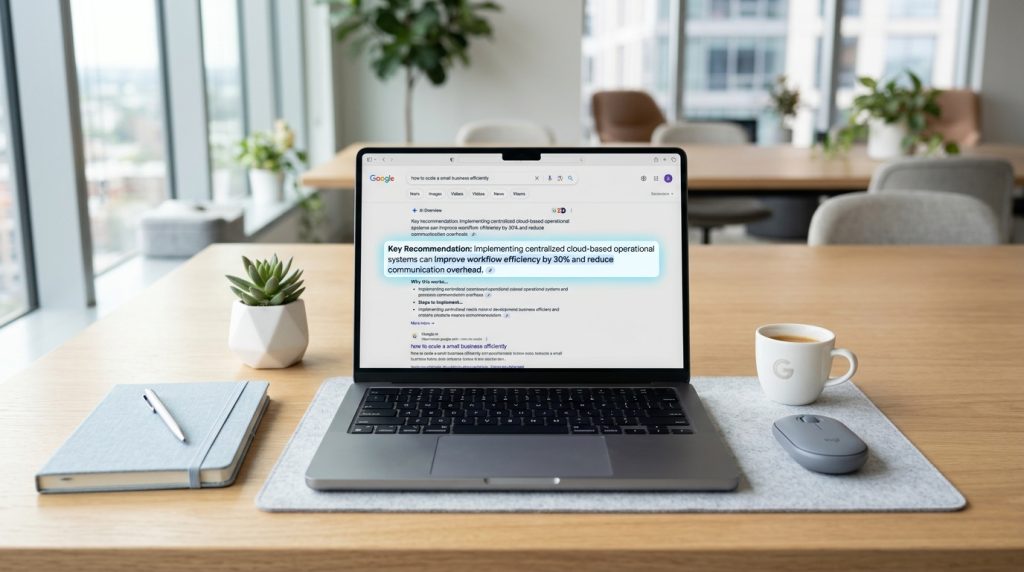
Something changed in how people find businesses. It happened gradually, then all at once. Instead of typing keywords into Google and clicking through ten blue links, buyers are now asking AI tools a question and getting a direct answer — complete with a business recommendation.
“What is the best web design agency for small businesses?” A buyer types that into ChatGPT or Google AI Mode. The AI responds with a paragraph recommending two or three specific agencies. Not a list of links. A direct recommendation.
Is your business one of those recommendations? If not, this guide tells you exactly how to change that.
What Is AI Search? A Plain-English Explanation
Traditional search works like an index. You type a query, Google matches keywords, and you get a list of links to websites. You click through, read, and decide.
AI search works differently. You ask a question in natural language. The AI reads thousands of web pages, synthesises the information, and gives you a direct answer. It may cite two or three sources. Everything else is invisible.
User query: “Best digital marketing agency for small business UK”
AI response: “For small businesses in the UK looking for digital marketing support, key factors to consider include experience with local SEO, transparent pricing, and a proven track record with SMEs. Agencies that publish detailed case studies and clear service pricing on their websites tend to deliver stronger results for small business clients. Look for agencies offering web design, SEO, and content marketing as a combined package rather than siloed services…”
That is the game now. The AI cites the sources it trusts. Everyone else gets nothing. Your goal is to become one of the sources the AI trusts.
How Big Is AI Search Right Now?
The numbers tell a clear story. AI search sends less traffic but drives more revenue per visitor than traditional search. A buyer asking ChatGPT for a recommendation is far closer to purchasing than someone casually browsing Google results.
Which AI Search Platforms Matter Most?
| Platform | How It Works | Why It Matters for Your Business |
|---|---|---|
| Google AI Overviews | Appears above all search results. Summarises answers from trusted websites. | Highest volume. Every Google search in USA and UK now shows AI Overviews for most queries. |
| Google AI Mode | Full conversational search replacing traditional results for complex queries. | Where buyers research services, compare options, and find agencies. Growing rapidly in 2026. |
| ChatGPT Search | Searches the web in real time and cites sources in its answers. | 100 million+ daily users. Business and professional buyers use this heavily for vendor research. |
| Perplexity AI | Answer engine that cites multiple sources with direct quotes. | Popular among tech-savvy buyers in USA and UK. Citations drive direct referral traffic. |
| Microsoft Copilot | Integrated into Windows and Edge browser. Uses Bing index plus AI. | Large enterprise buyer audience. Important for B2B service businesses. |
How Does AI Decide Which Businesses to Recommend?
This is the question every business owner needs to understand. AI search tools do not pick businesses randomly. They pull from websites that demonstrate three things consistently:
- Expertise. Does your website clearly explain what you do, how you do it, and why you are good at it? AI reads your content and judges credibility.
- Authority. Do other websites mention or link to yours? Are you cited as a source? Do you have genuine reviews? AI cross-references multiple sources.
- Trust signals. Is your website secure (HTTPS)? Is your information consistent across Google Business Profile, your website, and social media? Inconsistency reduces trust scores.
These three factors are what Google calls E-E-A-T: Experience, Expertise, Authoritativeness, and Trustworthiness. AI search engines use the same framework to decide who gets cited and who gets ignored.
6 Steps to Get Your Business Appearing in AI Search
Build a Website With Deep, Specific Content
AI search tools read websites the same way a very thorough researcher would. They look for content that clearly explains a topic with real depth and specific information. A homepage with five sentences about your services is not enough.
You need dedicated pages for each service you offer. You need a blog answering the specific questions your buyers ask. You need case studies showing real results. You need an About page that demonstrates genuine expertise with credentials, experience, and a named team.
What AI reads and cites from your website:
- Service pages with specific descriptions, processes, and outcomes
- Blog posts answering exact questions buyers search for
- Case studies with real numbers and named clients (with permission)
- FAQ sections with direct, clear answers
- About page with team names, experience, and credentials
- Pricing transparency — businesses that show pricing get cited more often
Write Content That Directly Answers Questions
AI search is built around questions and answers. When a buyer asks “what is the best way to get more leads from a website?” the AI scans thousands of pages looking for the clearest, most direct answer to that exact question.
Your blog posts and service pages need to answer questions directly in the first paragraph. Not build up to the answer over 500 words. The AI reads the first clear answer it finds and cites that source.
Question: How long does SEO take to show results?
AI-friendly answer format: “SEO typically takes 3 to 6 months to show meaningful results for most small business websites. The timeline depends on three factors: how competitive your target keywords are, how frequently you publish new content, and the technical health of your website…”
Get Your Business Listed and Reviewed Everywhere
AI search tools do not only read your website. They cross-reference your business across Google Business Profile, Yelp, Trustpilot, industry directories, and social media. Consistency and volume of mentions across multiple platforms builds the authority signal that gets you recommended.
Priority listings for USA and UK businesses:
- Google Business Profile — non-negotiable. Must be complete with photos, services, and regular posts.
- Trustpilot — the most trusted review platform in the UK. High weight in AI recommendations.
- Clutch.co — essential for digital agencies and B2B service businesses. AI cites Clutch heavily.
- LinkedIn company page — AI reads LinkedIn for business credibility signals.
- Industry directories — any directory relevant to your niche adds an authority signal.
Add Schema Markup to Your Website
Schema markup is code you add to your website that tells AI search engines exactly what your business does, where you are, what you offer, and what your customers say about you. It is like giving the AI a structured data file about your business instead of making it guess from your text.
Most small business websites have no schema markup at all. Adding it gives you an immediate advantage over competitors in AI search results.
The schema types that matter most:
- LocalBusiness schema — name, address, phone, hours, service area
- Service schema — each service you offer with description and price range
- FAQPage schema — FAQ sections are cited frequently in AI Overviews
- Review schema — displays star ratings in search and feeds AI trust signals
- Article schema — marks blog posts as credible content for AI citation
Build Your Topical Authority With a Content Cluster
AI search does not just look at individual pages. It evaluates whether your entire website demonstrates deep expertise in a topic area. A website with 20 blog posts all covering different aspects of web design and digital marketing looks far more authoritative than a website with one generic post.
This is called topical authority. The more comprehensively your website covers a topic, the more likely AI tools are to cite you as an authoritative source on that topic.
How to build topical authority fast:
- Choose your core topic. For Global Digitz: web design and digital marketing for small businesses.
- Write a pillar post. One comprehensive guide covering the topic broadly (2,000 words minimum).
- Write cluster posts. 8 to 12 blog posts each covering one specific subtopic in depth.
- Interlink them all. Every cluster post links back to the pillar. The pillar links to every cluster.
- Publish consistently. One new post per week signals to AI that your site is active and current.
Get Mentioned on Other Websites
When other websites mention your business, link to your website, or quote your content, AI search tools treat this as a vote of confidence. The more credible the website mentioning you, the stronger the signal.
You do not need hundreds of backlinks. Five mentions from genuinely relevant, credible sources outperform fifty from low-quality directories.
The most effective ways to get mentioned in 2026:
- Guest posts. Write one genuinely useful article for an industry website or local business publication. Include a link back to your site.
- Podcast appearances. Business podcasts in the USA and UK often publish show notes with links to guest websites. Strong AI citation signal.
- Help a Reporter (HARO). Journalists use this to find expert sources. Being quoted in a news article gives you a high-authority mention.
- Partner pages. Ask complementary businesses to list you as a recommended partner on their website.
- Client websites. Ask clients you have built sites for to add a “website by Global Digitz” credit with a link.
How Long Does It Take to Appear in AI Search?
What to expect and when
Schema markup and Google Business Profile updates: 2 to 4 weeks. Content improvements and new blog posts: 2 to 4 months before consistent AI citations begin. Full topical authority with a content cluster: 6 to 12 months of consistent publishing. The businesses that start now will dominate AI search in their niche by the end of 2026. The ones that wait will spend 2027 trying to catch up.
Frequently Asked Questions
What is the difference between traditional SEO and AI search optimization?
Traditional SEO focuses on ranking in the ten blue links on Google’s results page. AI search optimization focuses on being cited inside AI-generated answers. The foundations overlap significantly — quality content, technical health, and authority signals matter for both. But AI search additionally rewards direct question-and-answer content formats, comprehensive topic coverage, and structured data markup more heavily than traditional SEO.
Do I need a separate strategy for each AI platform?
No. The same foundational work — quality content, schema markup, consistent business listings, and external mentions — improves your visibility across all AI search platforms simultaneously. Google AI Overviews, ChatGPT Search, and Perplexity all rely on similar signals. Build the foundation once and it works across all of them.
Will AI search replace Google completely?
Not in the near term. Google processes over 8.5 billion searches per day and AI Mode is being integrated into Google itself, not replacing it from outside. The shift is in how results are presented, from links to answers. Traditional SEO and AI search optimization are converging into one unified strategy focused on being the most credible, most useful source in your topic area.
Can a small business compete with large brands in AI search?
Yes. AI search actually levels the playing field in several ways. A small agency that consistently publishes expert content on a specific niche can outrank a large generalist agency for specific queries. AI rewards relevance and specificity. Being the clearest, most comprehensive source on “web design for small businesses in the UK” is more valuable than having a large budget and a generic website.
Is AI search optimization expensive?
The core tactics — quality content, schema markup, business listings, and internal linking — cost time, not money. A consistent blog publishing schedule, properly structured pages, and active business profiles are all achievable without a large budget. The investment is in expertise and consistency, not in paid placements or ad spend.
Get Your Business Visible in AI Search
We audit your website, identify your AI search gaps, and build the content and technical foundation that gets you cited. Free initial audit. No obligation.
Get My Free AI Search AuditQuestions first? WhatsApp Global Digitz