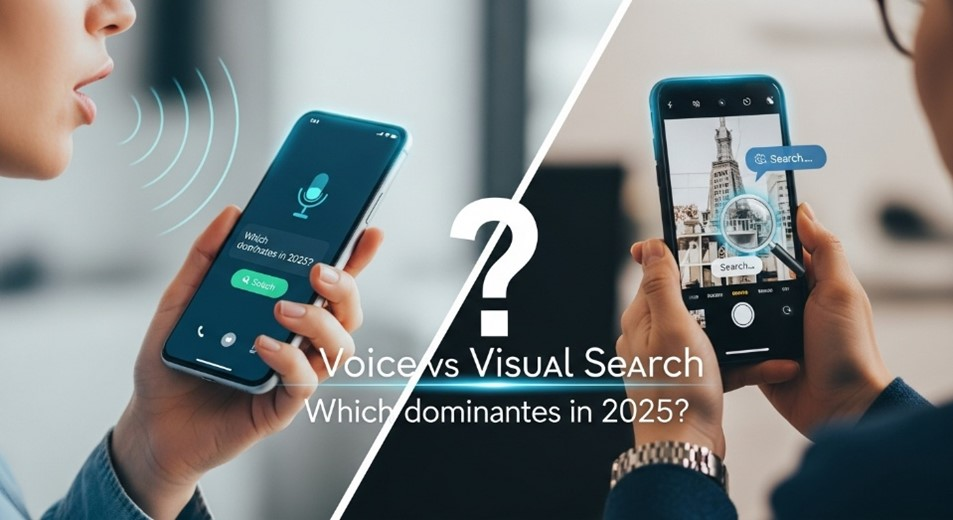
The idea of searching on the internet has shifted beyond typing. With the introduction of mobile cameras and smart speakers equipped with artificial intelligence, the trend has shifted towards image and voice search for finding information on the internet. To thrive with Advanced Technological Solutions, businesses must understand which one of the voice and visual search methods dominate or how both coexist. Understanding the dominant search methods is critical for staying relevant, visible, and ensuring maximized conversion.

Voice search
Visual search
Visual search involves the use of photos, images, or a camera to search for specific items. The example of visual search includes Amazon search by image, Google Lens, and many more. Visual search helps identify products, styles, and objects in a scene and provides relevant results.

The latest statistics and trends
Voice search
The data point indicating how voice search is performing in 2025 is as follows.
| Metrics | Statistics and Trends |
| The percentage of global internet users who use voice search | 20.5% |
| Number of voice assistants globally used | 8.4 billion |
| US users of voice assistants | 153.5 million |
| Voice search usage on mobile | 27% people use voice search on mobiles |
| Accuracy of voice assistants | 93.7% accuracy |
Visual search
The following statistics indicate that visual search is also gaining popularity.
| Metrics | Statistics and Trends |
| Percentage of people using visual search while online shopping | 36% |
| Market size and growth of visual search | The market for visual search software or global visual content is growing at a CAGR of 15.6%. |
| The effect of visual search on e-commerce | The site that offers a “visual search” feature experienced a 20% increase in order size. |
| Preference of Gen Z | 63% of Gen Z see visual search as the future |
Voice search vs visual search
| Dimensions | Voice search | Visual search |
| Natural language context | Voice search is excellent for conversational queries. It provides Voice Assistant responses and is suitable for hands-free usage. | Visual search is relatively less conversational. It relates more to what the user sees, rather than what they verbally ask. |
| Local needs/ immediate needs | Voice search is commonly used for local queries, often involving keywords like “near me.” It is more time sensitive and effective when the user is busy. | Visual search is valid when people see something and want to find it visually. |
| Shopping e-commerce | Voice search is not rich for browsing. It is more helpful in asking about availability or basic product information, or for quick reordering. | Visual search is powerful for e-commerce as it helps find similar items with identical styles through visual inspiration. |
| Trust and confidence | The trust and confidence in voice search depend on the accuracy of the results. | Visual search enhances confidence by allowing users to see precisely what they want, which in turn facilitates informed decision-making. |
| Accessibility and adoption | Voice search is much accessible through phones and speakers. Moreover, many users have already adopted voice search. | Visual search requires good input and a camera. However, sometimes the environment may not be ideal for image-based search. |
What drives the adoption of voice search and visual search?
Voice search
It is usually used when:
- Hands are busy with anything like cooking, driving or cleaning.
- A quick response is needed.
- Devices have built-in OS support voice search (phones, laptops, smart speakers, etc.)
Video search
It is usually used when:
- A user cannot describe something in words, but can search through images.
- Shopping for a product based on style, inspiration, and product matching.
Barriers for voice and visual search
Voice search: Accent recognition, noisy environment, and privacy concern.
Visual search: Lighting disturbance, image quality, convenience in camera usage, relatively slow speed, and more data usage.
Implications for digital marketing and SEO
How to optimize a website by using these trends while creating content or an online store.
Voice search optimization
- Using conversational and question-based keywords (What is the best option….)
- Creating a FAQ style section that matches well with how people speak.
- Ensuring mobile friendliness, efficient page loading speed, and clear information about local businesses (phone number, address, timings, etc.).
Visual search optimization
- Creating a high-quality image and structuring data around this.
- Using image compression and working on speed optimization to ensure fast loading.
- Good metadata and consistency in tagging and naming images.
Who will lead in 2025?
Based on current data and analysis:
- Voice search is more mature in handling simple information queries, quick tasks, and local searches.
- Visual search is experiencing growth in product discovery, inspiration, and shopping, particularly among younger demographics (millennials and Gen Z).
- The dominance of one over the other is difficult to say – for some, voice search dominates, while for others, visual search is preferred.
Hybrid trend
A multi-model search that integrates both visual and voice search will be the future. Brands need to consider embracing both of these trends, such as Google’s “Search Live,” which combines voice and camera. Multimodal experience (voice + visual) will be the real “next frontier”

How can you optimize?
To stay ahead in the present competition, you should:
- Evaluate the website’s visual content to ensure that all images are correctly tagged, named, and load quickly.
- Consider creating content targeted voice queries by identifying the questions that users usually ask and using H2/H3 headings.
- Ensuring that the Google Business Profile is up to date, as voice queries are becoming increasingly dominant in local searches.
- Testing the visual search feature.
- Monitor analytics to determine if the website is attracting traffic through visual or voice search, and adapt your content accordingly.
Conclusion
Visual Search and Voice Search are both powerful tools and are growing at a breakneck pace. Year 2025 demonstrated strong growth in voice search due to its convenience, simple queries, speed, and local information. Meanwhile, visual search is growing in product discovery and as a source of style inspiration. It is more valuable when the user finds it easy to search by showing the image rather than describing in words.
Instead of choosing one over the other, the practical strategy is to opt for a hybrid trend that supports both (voice + visual). Brands that effectively embrace these trends will lead the marketing, dominate SERPs, ensure improved user engagement, and boost conversion rates.