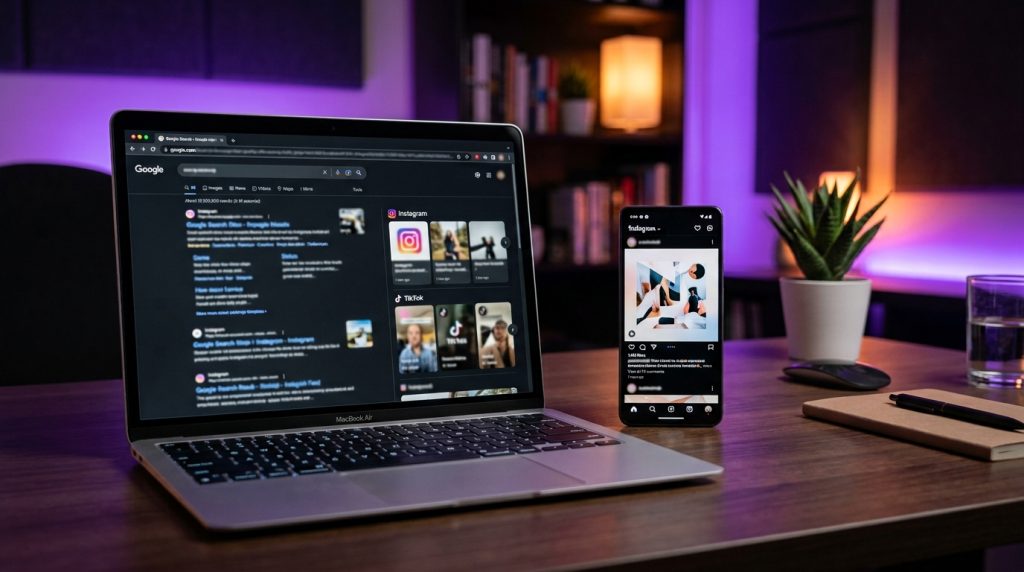
What is social SEO and how do you get your social media posts to show up in Google search? This is becoming one of the most important questions in digital marketing, because the line between social media and search has essentially disappeared. This guide covers 7 proven tactics for 2026.
Social Media · SEO · 2026
Social SEO: How to Get Your Social Media Posts to Show Up in Google Search
Your Instagram captions and TikTok videos can now rank in Google. Most businesses have no idea this is happening, let alone how to use it. Here is exactly how.
What is social SEO and how do you get your social media posts to show up in Google search? This is quickly becoming one of the most important questions in digital marketing, because the line between social media and search has essentially disappeared.
Search this exact question on Google right now: “best coffee shop near me.” Alongside traditional website results, you will likely see Instagram posts, TikTok videos, and Reddit threads appearing directly in the results. That is social SEO in action, and if your business is not optimising for it, your competitors’ social posts may be outranking your entire website.
What Is Social SEO? A Plain-English Explanation
Social SEO is the practice of optimising your social media content, captions, hashtags, and profiles so they can be discovered both within the social platform’s own search bar and directly inside Google search results.
This matters for two connected reasons. First, younger buyers increasingly search directly on TikTok, Instagram, and YouTube instead of Google, treating these platforms as their primary search engines. Second, Google itself now indexes and displays social content, particularly from Reddit, YouTube, TikTok, and Instagram, directly inside its own search results pages.
Search query: “best digital marketing agency for small business”
What appears on page one: Two traditional website results, one Reddit thread discussing agency recommendations, one YouTube video review, and one Instagram post from an agency showing client results.
Why This Shift Happened
Google’s own deal with Reddit, giving Google direct access to Reddit’s content and discussions, was one of the clearest signals of this shift. Forum and community content, along with short-form video, is now treated as a legitimate, trustworthy search result by Google, not just a social media post buried inside an app.
Marketers are already responding. Treating social platforms as search channels and optimising captions and on-screen text for platform queries is now considered one of the essential strategic moves for 2026, not an experimental tactic.
Which Platforms Actually Get Indexed by Google?
| Platform | Google Indexing | What Ranks Best |
|---|---|---|
| Very strong, direct partnership with Google | Threads with detailed, specific discussions and questions | |
| YouTube | Very strong, owned by Google | Videos with clear titles, descriptions, and captions matching search terms |
| TikTok | Growing steadily through Google partnerships | Videos with clear on-screen text and keyword-rich captions |
| Moderate, improving through public profile indexing | Posts with keyword-rich captions and consistent hashtag use | |
| Strong for professional and B2B queries | Articles and posts with clear professional keyword use | |
| Weak, mostly limited to public business pages | Business page info and reviews rather than individual posts |
7 Ways to Optimise Your Social Media Posts for Search
Write Captions Like Search Queries, Not Just Captions
Most business social media captions are written to sound catchy. Search-optimised captions are written to match what a real person would type into a search bar. Both can coexist in the same caption if you structure it correctly.
Add On-Screen Text to Every Video
For TikTok and Instagram Reels, Google and the platforms themselves increasingly read on-screen text, not just captions, to understand what a video is about. A video with no text overlay is far less discoverable than one with a clear, keyword-relevant headline burned into the first three seconds.
Use Specific Keywords in Your Bio and Profile
Your social media bio is searchable text, both within the platform and increasingly by Google. A vague bio like “Digital marketing agency ✨” tells search engines nothing useful. A specific bio tells both humans and algorithms exactly who you serve.
Turn Your Best Posts Into Blog Content
Repurposing your top-performing social content into a longer blog post creates a powerful compounding effect. The blog post ranks in traditional Google search, the original social post ranks in social and platform search, and each reinforces the other’s authority when properly linked together.
Answer Real Questions, Not Just Trends
Content built purely around trending audio or formats fades within days. Content built around answering a genuine, recurring question your customers ask keeps generating discovery traffic for months, because it continues matching real search queries long after the trend has passed.
Engage Authentically Instead of Overproducing
Authentic, less polished content now consistently outperforms heavily produced content, with the large majority of marketers agreeing that authenticity drives stronger results in 2026. This matters for search visibility too, because platforms and users both favour content that feels genuine over content that feels like an advertisement.
Build Community Before You Need It
Building community proactively is increasingly viewed as a hedge against algorithm volatility, meaning an engaged following protects your visibility even when platform algorithms change unexpectedly. Comments, shares, and saves are increasingly treated as trust and relevance signals by both the platforms and Google.
Quick Self-Audit: Is Your Social Media Optimised for Search?
Social SEO Checklist
Why This Matters More for Small Businesses Than Big Brands
Large brands already dominate traditional Google search through years of accumulated authority and backlinks. Social SEO creates a genuinely level playing field, because platform algorithms reward relevance, consistency, and engagement over raw domain authority. A small business posting specific, search-optimised content consistently can outrank a much larger competitor in social and platform search results, something that is far harder to achieve in traditional SEO.
Frequently Asked Questions
What is social SEO?
Social SEO is the practice of optimising social media content, including captions, hashtags, on-screen text, and profile information, so it becomes discoverable both within a platform’s own search function and directly inside Google search results. It combines traditional SEO principles with social media content strategy.
Can Instagram and TikTok posts really show up in Google search?
Yes. Google increasingly indexes public content from TikTok, Instagram, YouTube, and Reddit, particularly when that content directly matches a search query. This is a significant shift from previous years when social content rarely appeared in traditional Google search results.
Do hashtags still matter for social SEO in 2026?
Hashtags matter less for platform discovery than they did several years ago, but specific, relevant hashtags still help categorise content for platform search. The bigger factor in 2026 is caption text and on-screen video text, which carries significantly more search weight than hashtags alone.
Which social platform is best for search visibility right now?
YouTube and Reddit currently have the strongest direct integration with Google search due to Google’s ownership of YouTube and its data partnership with Reddit. TikTok is growing quickly in this area, while Instagram indexing is more limited but steadily improving.
How is social SEO different from traditional SEO?
Traditional SEO focuses on optimising a website’s pages, technical structure, and backlinks to rank in Google. Social SEO focuses on optimising social media content and profiles to be discovered both inside a platform’s own search bar and within Google’s search results. The two strategies increasingly overlap and reinforce each other when used together.
Do I need a large following for social SEO to work?
No. Social SEO rewards content relevance, specificity, and consistency more than raw follower count. A small business with a modest following can rank well in platform and Google search by consistently posting specific, keyword-relevant content that directly answers real search queries.
Want Your Social Content Working as Hard as Your Website?
We build combined SEO and social media strategies that reinforce each other. Get a free audit of your current social profiles and content.
Get My Free Social SEO AuditPrefer to chat first? WhatsApp Global Digitz